

Imagine your biggest client saying in a meeting: “Soon, we will only buy products with a Digital Product Passport.” Will you know what is expected of you, or will you be completely caught off guard? Sooner or later, that question will also land on your desk. It's time to delve into it.
In this blog, you will read what the Digital Product Passport (DPP) is, when it becomes mandatory, and how it helps you with your sustainability reporting or customer obligations.
What is the Digital Product Passport?
The DPP is a digital identity card for products. A QR code on the product, packaging, or manual provides access to detailed information. From origin, material composition, and environmental performance, to repairability, compliance status, and end-of-life guidelines for the product.
Key objectives
- Supporting more sustainable product design.
- Promoting reuse, repair, and recycling.
- Ensuring traceability in complex, global supply chains.
- Bridging the gap between increasing consumer demands and regulations (such as ESPR, CPR, CSRD).
- Providing transparent, reliable, and up-to-date product information to consumers and professionals.
The DPP aligns with the European Green Deal and is legally enshrined in two regulations: the Ecodesign for Sustainable Products Regulation (ESPR) for the broad EU market, and the Construction Products Regulation (CPR) for the construction sector.
When does the DPP apply to your products?
The obligation will be in phases implemented. In April 2025, the EU established the first priority list – the product groups for which the DPP will soon be mandatory:
- Textiles, aluminum, and tires: from 2027
- Batteries: from February 2027 for electric vehicles and industrial batteries over 2 kWh.
- Metals: likely mandatory from 2027/2028 (rules to be announced in 2026, with an 18-month transition period)
- Furniture: from 2028
- Mattresses: from 2029
- Construction materials: separate timeline as they are subject to both the ESPR and the CPR
From 2030, the legislation will be systematically expanded to almost all product categories.
Do you make products not on the list above? Then your company will deal with it later, but your customers might do so sooner. Large buyers who are themselves subject to reporting obligations, such as the CSRD, will increasingly request product data from their suppliers in the coming years.
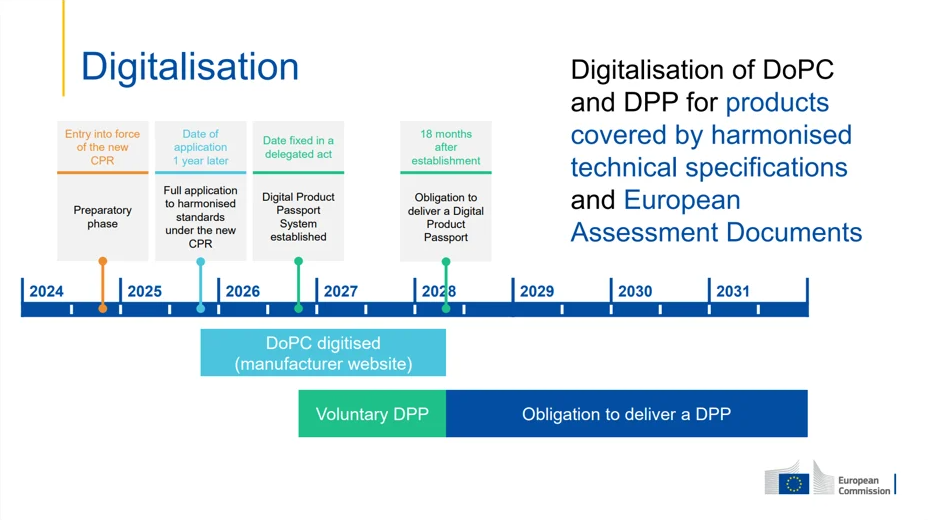
How do you start with the DPP?
You don't have to wait until the obligation for your sector comes into effect. In fact, those who start now will have an advantage later.
A good first step is to check what product data you already have. Have you previously life cycle assessment (LCA) or a carbon footprint analysis conducted? Then you already have some of the information required for a DPP.
Still have questions or would like an expert by your side to guide you through the DPP process? We're here to help.
Send us a message.
Want to know more?
What information does a DPP contain? What is its link to CSRD? How can I prepare?






.svg)
