
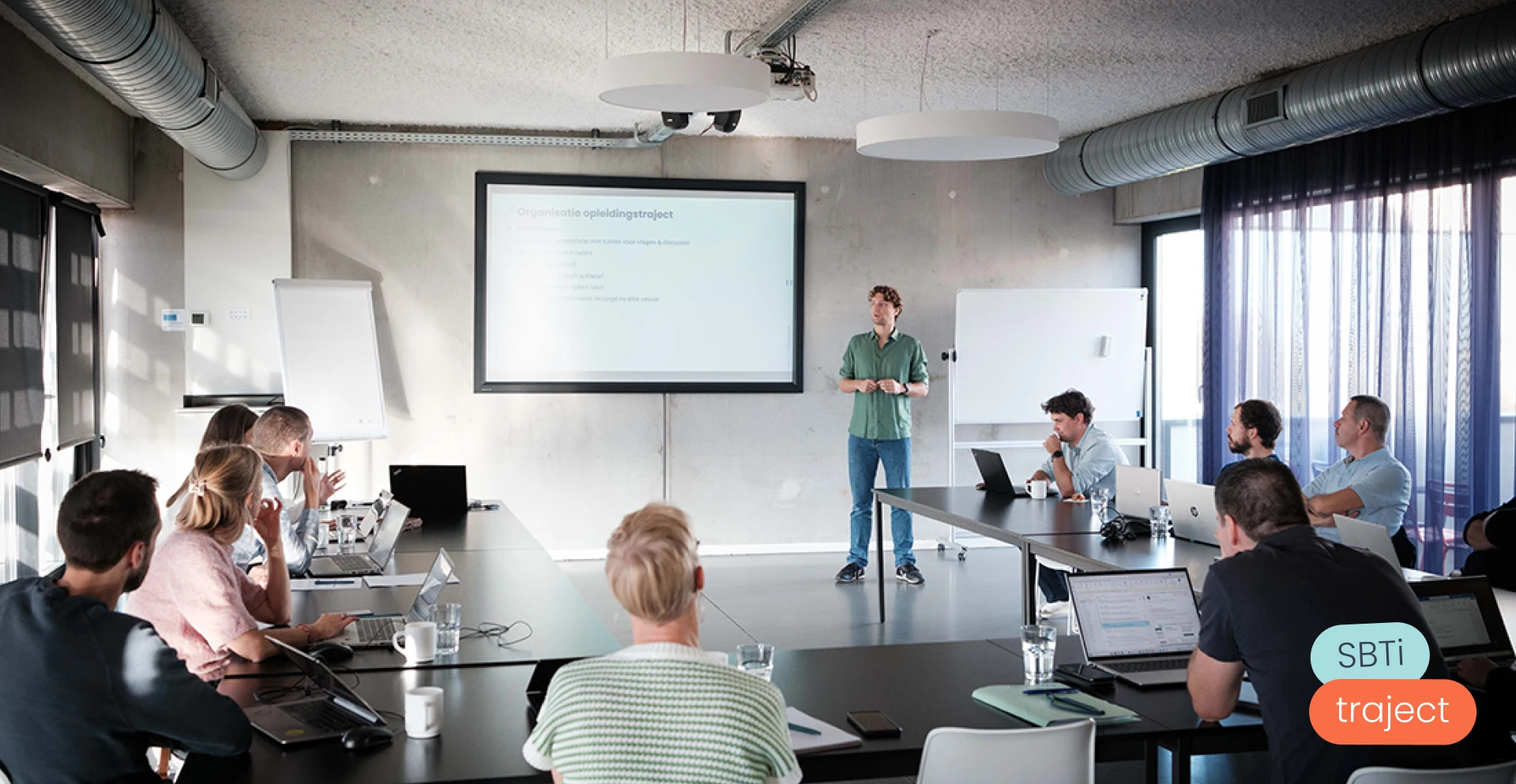
Johannes Spaas guides companies through their climate transition, from carbon footprint to Science-Based Targets. In September 2025, he was one of the first experts in Belgium to obtain the SBTi Certified Expert certificate. This proves he has a thorough grasp of the SBTi methodology – from emissions inventory and targets to the validation process.
You can refresh your knowledge of the SBTi basics via this article. Here, we're talking about the practical side: the considerations companies need to make, the mistakes Johannes encounters, and an honest answer to whether it's right for your business.
Why did you want to obtain this certificate?
There's no such thing as a certified carbon accountant. A 'regular' accountant needs a diploma, but anyone can claim to do carbon accounting, especially since carbon accounting software has become available. Previously, you really had to understand the rules of the Greenhouse Gas Protocol to truly understand how to calculate a carbon footprint in Excel. Now, anyone with a software license can set something up that resembles a carbon footprint, without truly grasping the rules.
An SBTi certification is one of the few ways to demonstrate a thorough mastery of the methodology. It also goes beyond carbon footprinting. You are assessed on how you formulate targets, build a reduction pathway, and navigate a validation process. It's not an all-encompassing quality mark, but it does indicate that you know what you're doing. For me, that's a no-brainer.
The process has changed my perspective on carbon footprints. With SBTi, completeness is crucial. They won't comb through your invoices, but they will check if you've included all emission sources.
You completed seven assessments. How have they changed your approach?
A key takeaway was how you can combine different types of targets into a tailored reduction pathway. Two examples to make it less abstract: Consider a distributor whose suppliers are much larger than them. You can't impose much on them. So, you work with supplier engagement targets, committing to keep suppliers motivated to work on emission reduction themselves. The same distributor also has significant transport movements. Their main transporter had its own commitment of a 30 percent reduction per tonne-kilometer by 2030. That fits perfectly into the SBTi narrative but is a completely different type of target. Within one pathway, you combine these two.
Another example is a food industry production company with milk as its primary raw material. They face a fundamental choice: either partially replace cow's milk with plant-based alternatives, so emissions decrease in absolute terms, or manage emissions per liter, for example, through the type of feed and livestock or the design of the stable. SBTi offers the flexibility to combine these approaches into one coherent reduction pathway.
I now apply this focus on completeness to every project. Transportation from factory to distribution center, from distribution center to store, cold storage, pallet movements... everything must be included.
How do you get internal buy-in for SBTi if it's not mandatory?
SBTi demonstrates that your climate targets are aligned with the Paris Agreement. It is recognized in frameworks such as EcoVadis, the CO2 Performance Ladder and CDP.
However, the greatest added value might be in the process itself. It helps you to carbon footprint properly calculate. Which suppliers are important, where are your levers, how do you combine different objectives for your specific context? That exercise is valuable in itself, regardless of the certificate. And for many companies, it is simply a prerequisite to remain a supplier to certain retailers. The investment does not outweigh the loss of an important contract.
When do you advise a company against starting with SBTi?
I have already advised companies against doing it. Consider an SME that is growing rapidly and wants to join via the simplified SME route. Through that route, you can only set an absolute target. This means your total emissions must decrease, regardless of whether your production increases. If you are in a growth phase, you still have to absolutely reduce by 42 percent by 2030. But in terms of intensity, the required reduction can increase to 80 percent or more, depending on how fast you grow. That is simply not feasible.
Another example: a printing company that uses solvent-based inks. These solvents are extracted and incinerated, resulting in CO₂ emissions. To decarbonize, you need to replace your entire installation with water-based systems. Your energy consumption will initially increase, and your entire production process will change. If you have to set a target for 2030, but only plan to make that investment in 2040, the timing is off.
In large enterprises, you often see a gradual process: one year you replace this, the next year that. For smaller companies, it's often all or nothing. At some point, you replace your natural gas heating with a heat pump powered by green electricity and instantly drop from 100 to 30. But SBTi is not prepared for that kind of sudden change.

When is it, in fact, a logical step?
If a client asks for it, the decision is quickly made. For many companies, it comes down to this: losing a retailer as a client or investing 15,000 euros in validating your targets. Then losing that client is the greater evil.
But even without direct client pressure, there is a logical moment. If you already have a solid carbon footprint and want to demonstrate that your reduction targets are scientifically substantiated, SBTi is one of the few ways to prove it. It is more credible than ‘we are working on it’.
And for companies that are already working with EcoVadis, the CO2 Performance Ladder or CDP: SBTi strengthens your position in each of these initiatives. It's not a substitute, but it adds significant weight to your climate strategy.
What does an SBTi journey cost?
I'll break it down into three categories. As an SME, you pay 1,250 to 2,000 dollars in validation fees to SBTi, plus the calculation of your carbon footprint, somewhere between 3,000 and 5,000 euros. In total, that comes to 5,000 to 7,000 euros.
Are you a large enterprise without FLAG emissions? Then your footprint calculation becomes more complex: expect to pay 8,000 to 10,000 euros, depending on the number of sites and the complexity of your value chain. The submission fees to SBTi then start from 13,000 dollars for companies with less than 250 million euros in revenue. For higher revenues, that increases to 16,000 or 21,000 dollars.
If you're in the food sector, a FLAG add-on applies. A company with less than 250 million euros in revenue pays 13,000 dollars for the near-term validation, plus 9,000 dollars for FLAG. That totals 22,000 dollars. For higher revenues, prices increase further.
An SBTi journey can feel like a bitter pill to swallow, because you're paying for a validation whose added value you don't immediately notice in your daily operations. But it's an investment in market access, and a one-time one. The update of your scope 1, 2, and 3 the following year might cost 5,000 euros. And that SBTi submission extends over roughly five years, until you need to do a recalculation.
What are common mistakes in an SBTi journey?
It often starts with the scope definition. Suppose you have separate sales and production entities. If only the sales entity has SBTi targets and production is not included, you won't cover your largest emission sources. You need to carefully consider which entities to include.
Another common mistake: relying too heavily on spend-based calculations. If you calculate all your emissions based on the euros you spend, it's difficult to reduce them afterwards. After all, you'd have to spend less, and that's not an option in many cases. With SBTi, 67 percent of your scope 3 emissions must be covered by targets. I always recommend ensuring that this 67 percent is not calculated spend-based, so you can effectively drive reduction.
Another mistake: submitting without a decarbonization plan. SBTi asks you to indicate how you expect to achieve your targets. If you don't have an answer to that, you're committing yourself to promises you can't keep.
What you also want to avoid are gaps in your calculation that you only discover during the validation process. Adjusting an assumption or correcting a transport distance is quick. But if you haven't calculated an entire category, that's a different story. A preliminary check with someone familiar with the methodology is a good investment.
Many changes are coming to the SBTi standard soon. Wait or start now?
The Net-Zero Standard is being revised, and that also changes the rules for near-term targets. However, those who submit today or in 2027 will still fall under the current rules. Targets submitted in 2025, 2026, or 2027 will remain valid until the end of their term.
What will change soon? You will have to set separate scope 1 and scope 2 targets, whereas today you can set a combined target. Within scope 2, both a location-based and a market-based target will be required. Simply signing a green contract will no longer suffice. And within scope 3, all categories representing more than 5 percent of your emissions must be covered by targets.
My advice? Start now. Based on the draft text of version 2.0, the requirements are becoming stricter. If you start now, you'll benefit from the slightly more accessible current standard. Moreover, if a client asks you for SBTi today, they won't allow you to wait another two years.
And apart from legislation: SBTi is currently driven much more by stakeholder expectations than by regulation. Clients, banks, investors... that pressure won't disappear with deregulation. The first step is always: calculate your emissions inventory. From there, you can make an informed decision.
Do you want to know if SBTi is relevant for your company?
We'll check together if it's feasible for your situation.





.svg)
