
Why oyster reefs are so important
Flat oysters are known as “ecosystem engineers”. When they attach to each other in large numbers, they form reefs that:
- provide shelter, food, and breeding grounds for various fish and invertebrate species
- filter the water and capture excess nitrogen
- stabilize the seabed and thus provide extra protection for our coast against the effects of climate change
The restoration of this habitat therefore not only enhances the natural value of the North Sea, but also contributes to more robust, climate-resilient coastal ecosystems.

Collaboration between four partners
BELREEFS unites Jan De Nul, the Institute for Natural Sciences, Shells & Valves and Mantis Consulting. Commissioned by the Marine Environment Service (FPS Public Health) we jointly provide the knowledge, materials, and logistics to execute the project.
BELREEFS is part of action T4.8 of the LIFE Belgium for Biodiversity program (B4B) and aligns with the new European Nature Restoration Regulation, which requires each member state to develop a restoration plan.
“The North Sea is not only an economic engine, but also a unique natural environment that we must protect diligently. Releasing young oysters is an investment in biodiversity and climate resilience. With projects like BELREEFS, we aim to ecologically restore at least 20% of the North Sea by 2030.”
— Annelies Verlinden, Minister of Justice and the North Sea
A year of preparation, now results
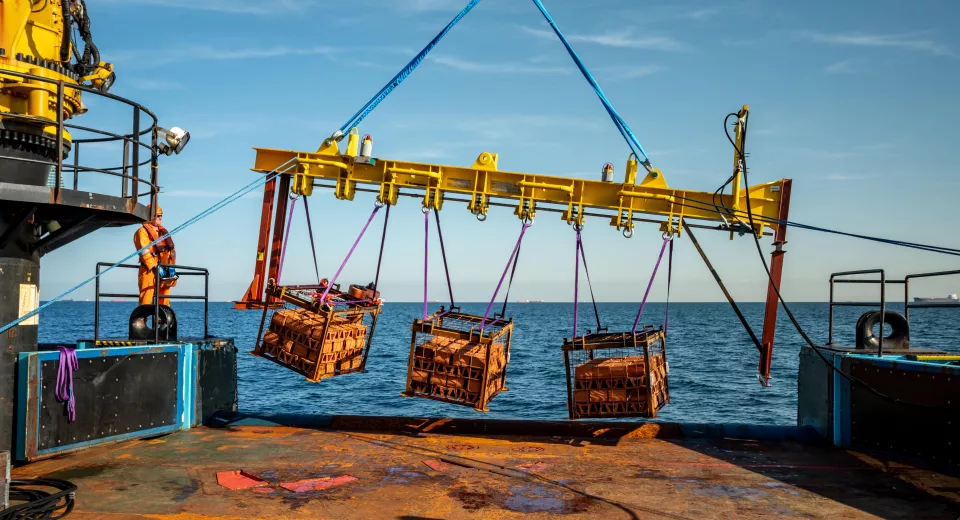
The operation is the result of more than twelve months of research and preparation. The project team evaluated various biodegradable materials as reef substrate and ultimately chose fired clay bricks (Oyster Heaven). Oyster larvae were “seeded” onto the bricks and cultivated for several more weeks. Part of the cultivation took place in the Netherlands (Stichting Zeeschelp), while local cultivation capacity is also being developed in Ostend.

From laboratory to seabed
Once the young oysters were firmly attached, an installation vessel left the port of Ostend to place almost 1,900 reef stones covered with oysters around the legally protected wreck “Kilmore”, on a gravel bed at a depth of 30 m. The location was selected based on seabed research by the Royal Belgian Institute of Natural Sciences and in close consultation with the fishing industry via the Redercentrale. The goal is optimal oyster survival and minimal disturbance to other maritime activities.
“Flat oyster reefs are the coral reefs of our North Sea. These ‘ecosystem engineers’ attract countless fish and other animal species, forming a rich and vibrant underwater landscape. With the BELREEFS project, we are taking a crucial first step towards restoring these valuable ecosystems in our own North Sea. We are very proud that Mantis can contribute to this.”
— Mathieu Wille, Blue Economy project leader at Mantis
Monitoring and then scaling up
The installation marks the beginning of an intensive three-year monitoring program. It is expected that over 30,000 young oysters will reach maturity, reproduce, and form a self-sustaining reef that can grow over time without further human intervention. The collected data will guide future scaling-up plans for nature restoration.
Furthermore, the project aligns with the guidelines of the Native Oyster Restoration Alliance (NORA), so that we always work with the best available knowledge and international experience.

Mantis Consulting and the Blue Economy
We believe that technological progress and nature restoration go hand in hand. Within BELREEFS, we contribute our expertise in ecological design and project coordination to ensure the successful reintroduction of flat oysters. Some of the techniques used will soon also be applied to the nature-inclusive design of offshore infrastructure, such as wind farms and cable routes within Natura 2000 areas.
Read more about the Blue Economy
Offset your CO2 emissions in the Blue Economy






.svg)
