

Trafiroad is a Belgian player in traffic signaling and mobility-supporting infrastructure, with approximately 530 employees spread across various entities. The company primarily works for public authorities and infrastructure managers: construction sites along regional roads, intersections, highways, and village centers. A sector not immediately associated with sustainability reporting.
Yet, the company chose to produce that report. Voluntarily.
“Reporting will eventually become mandatory. Instead of waiting to see which way the wind blows, we prefer to be proactive,” says CFO Bruno Van den Eede. “It's also good to have a structured document. Something to refer to when customers, suppliers, or banks ask questions about sustainability.”
Voluntary Reporting via VSME
For its reporting, Trafiroad opted for the VSME standard: a voluntary European reporting framework structured around the ESG pillars of environment, social, and governance. This was no coincidence.
“Because this reporting standard is less extensive than the detailed CSRD, it is also easier to manage.”
Van den Eede was looking for a workable framework that suited the organization's scale and allowed for further development in subsequent cycles. In collaboration with Mantis Consulting, Trafiroad conducted a double materiality analysis in 2024. This yielded six priority themes, three environmental and three people-oriented: energy and climate, circularity, environmental interaction, personnel policy, safety and health, and nuisance prevention.
The surprise: more was already happening than expected
What stood out during the exercise was how much was already being done.
“We were doing much more than we thought. In terms of our buildings, our heating methods, insulation, you name it.”
A few examples of achievements:
- 20,000 light points on regional roads, converted from traditional to LED lighting at the request of the Agency for Roads and Traffic. This results in savings of millions of euros annually.
- A first with STEDDY, a bio-based traffic post made from hemp that stores more CO₂ than is released during its production. It is also 100 percent circular.
- A second life for discarded bicycle batteries, which are integrated into rechargeable block batteries for temporary signaling. Result: less waste and raw materials.
- The switch to green energy, electric and hybrid aerial work platforms, and work vehicles.
At the same time, it also became clear where the obstacles lie.
“The biggest challenges are our rolling stock and the gas consumption involved in powder coating.”
That's precisely the kind of insight the exercise was meant to provide: showing what's going well and pinpointing where there's still work to be done.
Between planet and pocketbook
Trafiroad aims to reduce its combined Scope 1 and Scope 2 emission intensity by 20 percent by 2030, compared to the 2023 baseline year. In 2024, a reduction of 2.7 percent had already been achieved. A good start, but Van den Eede is realistic about what lies ahead.
“Greening our machinery fleet is far from straightforward. Alternatives often come with higher costs, for example, the hybrid aerial platform and electric site vehicle we've invested in. Some things are realistic, like switching to Belgian green electricity. Others are much more difficult, such as rolling stock. Purely financially, it sometimes doesn't make sense. At the same time, I am convinced that these efforts can create commercial opportunities, even if that's difficult to quantify.”
There's an honesty in that which isn't always present in sustainability narratives: not every green choice is a win-win. Some are a deliberate investment with an uncertain return.
A Group with Many Faces
An additional layer of complexity: Trafiroad operates through various entities, each with its own identity and activities, and has made several acquisitions in recent years. Implementing a uniform approach and consistent reporting across the entire group is no easy task.
“Within the group, Trafiroad is the largest entity and also the best organized in terms of processes and data management. In recent years, we have made several acquisitions. This complicates a uniform approach and reporting. But each time we go through the exercise, it gets smoother. At least, that's my feeling.”
Context and Approach
Van den Eede has been CFO for two years. The CO₂ reporting project landed directly on his desk. “The issue was assigned to me. I took it on. Then I started looking for a way to tackle it properly.”
That search led to an external partner. Van den Eede spoke with several parties, narrowed it down to two, and asked colleagues for feedback to make the final decision. In the initial phase, Bram De Keulenaere from Mantis was the point of contact. From the kick-off in January 2025, Johannes Spaas joined the discussions, and gradually the focus shifted to him.
The work rhythm that emerged was pragmatic. A bi-weekly meeting between Van den Eede and Spaas. A few extra sessions per year to update colleagues from the business units and gather feedback. And a report that gradually took shape, in parallel with the broader CO₂ Performance Ladder.
What struck Spaas: “When meetings were about paperwork and sustainability reports, there was little enthusiasm. But when it came to concrete matters like electrification and steps the business units could take, there was a lot of eagerness to contribute ideas. A kind of ‘bottom-up’ desire to become more sustainable.”
Embedded, Not Just Ticked Off
What's in place now: an ESG steering group comprising the CFO, Business Unit Managers, and the Facility Manager, which meets semi-annually. A report that serves as a starting point. And an organization that views sustainability more broadly than just emissions.
Because the report isn't just about the environment, but also about people. “We want to provide a pleasant and safe working environment for all our colleagues and are aware of the importance of sustainable employment. These concepts certainly have their merits, but we are also realistic. Night work, tight deadlines, urgent projects... they are inextricably linked to the nature of what we do.”
Here too, not a forced narrative, but an honest one. A contractor in a traditionally 'tough' sector that systematically prioritizes safety, training, and well-being – without losing sight of reality.
Collaboration and Ambitions
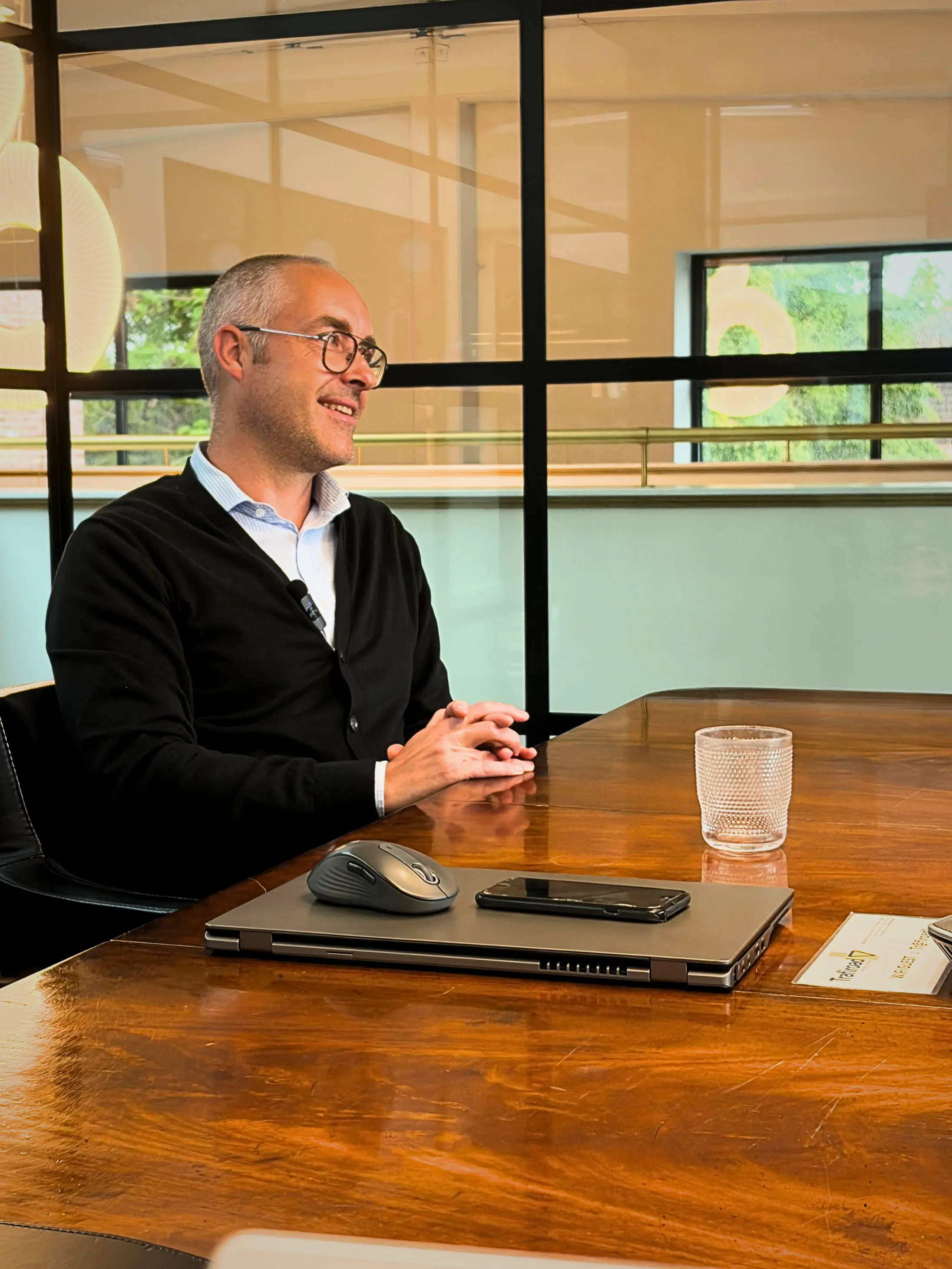
Ask Van den Eede what he would change if he had to do the project again, and nothing immediately comes to mind. “Everything about this collaboration went smoothly, nothing to complain about.” What likely contributed to this: from the partner selection onwards, there was open communication with operational colleagues. Several people who had to support the project were present when the final two candidates were being considered, and subsequently participated in formal meetings a few times a year.
Van den Eede openly acknowledges a certain tension. For some companies, a sustainability report is primarily 'a piece of paper for the client,' something to tick off a list. “Few find it an engaging topic to work on daily. For us, it's about both meeting requirements and being driven to do better.”
One area for improvement remains: “We now have a system, an action plan, and a list of concrete measures. But how to communicate that within the organization and keep it alive—there's still room for improvement there.”
Meanwhile, the collaboration with Mantis continues. This includes work on the CO₂ Performance Ladder, footprint calculations, and recently the EcoVadis questionnaire, which Trafiroad completes together with Mantis. “You need experts for that too.”
Make your services future-proof?
Are you also receiving more and more questions about sustainability from clients, suppliers, or banks? Mantis helps establish a structural sustainability policy, from VSME reporting to carbon footprint.



.svg)
